
This article precedes a special The Exam Man podcast episode of the same name, which will be released on Monday 19th August 2024
Schools spend a big chunk of their curriculum and planning time for exam year groups gearing up for external exams, punctuated by mocks and in-class assessments throughout the year. Students' hard work all leads to several weeks of external testing just after the Easter holidays, when there is often the sudden onslaught of a heatwave to further dial up the tension. The pros and cons of external assessments, the positives and challenges of digital exams- these are all well- trodden debates.
The incredible amount of work involved in planning and delivering exams within schools is also visible - but how many know- really know- what happens when the students’ time is up and the exam papers are collected, packaged up and sent off? Over the last few months, we have endeavoured to find out what happens to this most precious and irreplaceable cargo, asking students, examiners, exam boards and exams officers about their roles in the journey. In summary: the post exam processing process involves a kaleidoscope of complex systems on an unfathomable scale, during a flurry of intense summer activity across the UK. In a world where paper and pen and sending mail has dramatically reduced, paper and technology are of equal importance during this process, the best of the old and new woven together.
When students breathe a sigh of relief that their hard work is done and they turn their deserved attention to the long summer break, exams teams bundle up their papers and send them to the exam boards. This involves a dizzying array of postcodes, paper codes, registers, names in right places and additional sheets. Script packages are kept in secure storage at schools and other exam centres to wait for pickup by courier. The completed scripts are then transferred to the relevant awarding bodies (via Parcelforce’s central depot) for processing and marking, courier vans zigzagging up and down the country, ensuring every single individual paper finds itself in its rightful place.
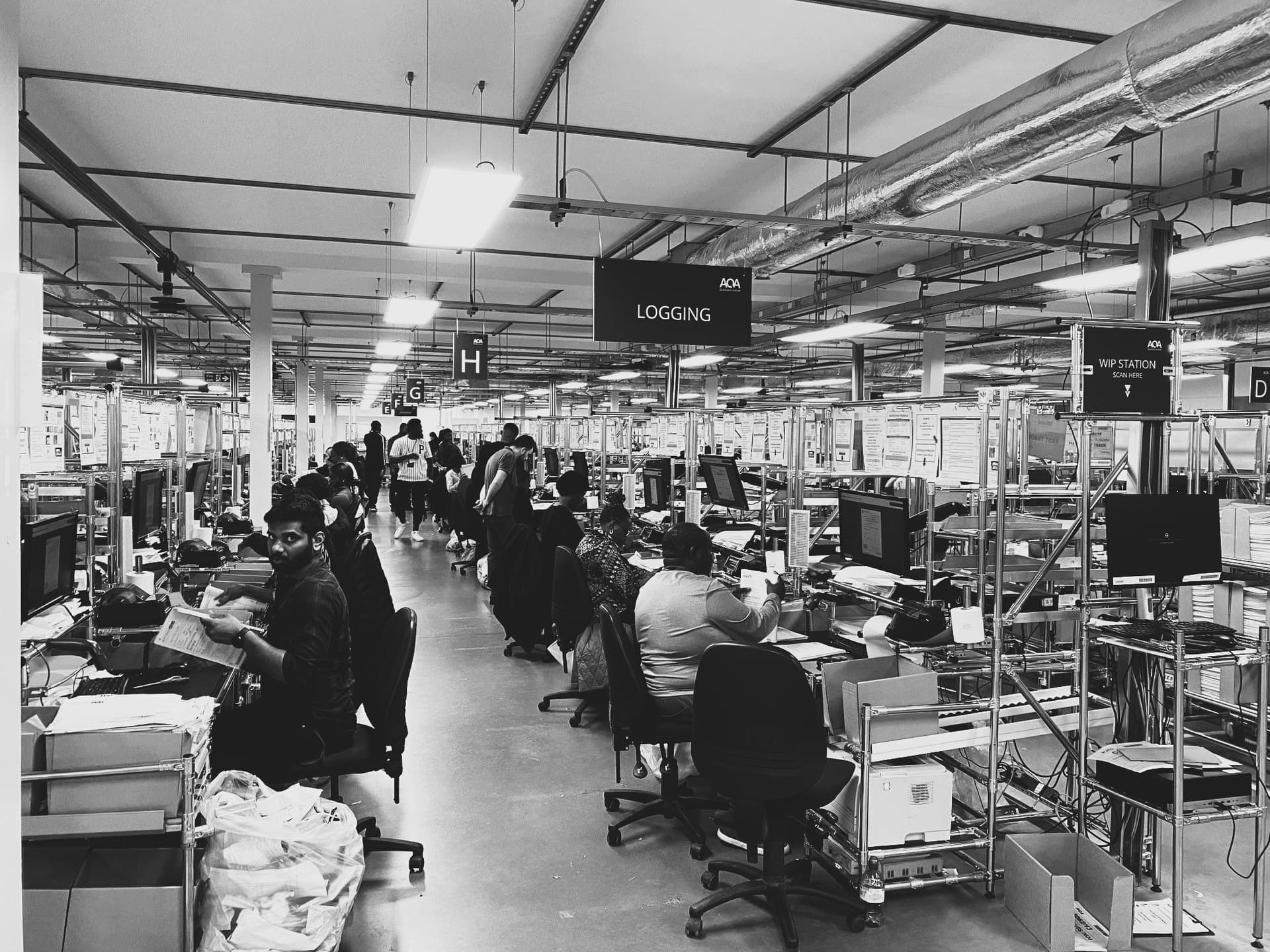
This is where our knowledge and understanding of what happens began to get a little hazy. When invited by AQA to visit their processing centre in Milton Keynes to see the operation for ourselves, we jumped at the chance. Following around the supremely knowledgeable Mark Collins, Head of Operations at AQA, we got the full lowdown on the vital and thoroughly fascinating work that he and his team do to help ensure that students get the results they deserve.
The scale was nothing short of staggering, the logistics mind-boggling. A huge warehouse where a vast team of dedicated permanent and temporary members of staff meticulously process and scan 3 million exam scripts per day safely and securely, throughout the day and the night. Exam scripts which are eventually marked online are scanned and kept in secure storage by the awarding bodies, and then exam scripts that need to be marked in hard copy are sent to individual awarding body examiners.
Examiners- most often teachers or senior leaders- follow the process of their awarding body, which will be a broadly similar process across the exam boards, except for some technicalities. Senior examiners then swoop in, to ensure that examiner marking is consistent with the awarding body mark scheme; that conversions from raw marks to UMS scores have been calculated accurately, and that the application of grade boundaries is correct. Results are issued to schools (centres, in exam parlance) by the awarding bodies as downloadable digital files 24 hours before they can be issued to candidates. Exams office staff and Heads of Centre- one of the many little-known responsibilities of a Headteacher- check and analyse candidate results to spot any anomalies and issues.
Centres then start to arrange sharing results with candidates the following day, which is another example of paper and technology coming together. Students are usually handed out envelopes by school staff on the day, surrounded by their peers in a flurry of anticipation, excitement and nerves. This is an immense privilege to witness and support- as students celebrate and commiserate their results and plan the next stage of their lives. Some students will have opted to receive their results via email, opening them in their own time and space.
The awarding bodies keep the physical scripts for approximately 6 months after the exams finish. AQA have them securely shredded to British standards and all the paper is recycled offsite with a specialist secure shredding company. During this 6-month period, another cohort of Year 11 students will have entered the final year of their GCSE's and teachers will be working hard to cover their subject curriculum before revision starts. Soon enough, there will be approximately 650,000 GCSE students who will sit down in the exam hall, open a crisp new booklet, and put pen to paper. And so it begins again...
Sophie and John Gaston are Directors of www.examscreen.co.uk, a transformative exam display tool used in 1500 UK and international schools and co-hosts of The Exam Man, the number 1 podcast about exams.